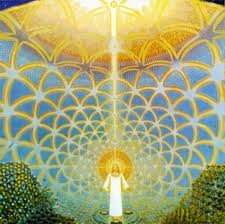
The Christ as Mirror and Key
The Renaissance of Spirit Series, by Jozef Dominguez and Julia Hope Price began with Remembering Wholeness: The Energetics of Healing for the Twenty-First Century. The second in the series is The Golden Thread: Awakening to the Feminine Divine. The following is an excerpt from “Chapter III: The Journey Home.” Jozef will expand on this topic, including a discussion of the Mystery of Golgotha, in future works.
In order to better understand the phases of spiritual evolution, we need only look to the life of Jesus, which reflects the entire course of spiritual birth and return within one brief lifespan. The major transitional stages of his life are a summation of the soul’s complete journey back to Source. These stages correspond to the five planes of energy: physical, emotional, mental, spiritual, and the final stage of at-one-ment.
The first phase is reflected allegorically in the Birth of Jesus. The Birth, the point at which the soul enters the body, represents the entry into physical matter from the spiritual dimension. This is the earliest stage of spiritual expression, the first lap of the longer journey home. During this stage, a person is most concerned with asserting human will through the five senses, and reacting to external stimuli as opposed to looking within. One may reside at this level for only a brief span of time or for many lifetimes.
The second stage is represented by the Baptism. This stage occurs when a person makes the moral-ethical decision to serve God. It happens when a person takes the conscious initiative to say, “I’m here, Lord. What would you have me do?” It is the stage of moving beyond personal wants and desires. Through the Baptism, we grow beyond self-serving attitudes and replace these with the desire to serve without reservation, and we begin to understand that serving God is truly to serve the collective.
At this point, when we ask God to work with us and when the Holy Spirit is activated in us, we have arrived at a new level of spiritual awareness that signifies entry into the second level of energy, the emotional plane. This is the place of establishing relationships between self and others and between self and Source. As a child, in the spiritual sense, we were most concerned with having our own needs met. Through the Baptism, we move into spiritual adulthood. Again, this is a stage that may encompass many lifetimes. As we master this level, we progress to the third level, the mental plane.
In the life of Christ, the third plane is seen in the Transfiguration. During this phase, we undergo a transformation that is spiritual in nature. This third, mental plane is a time of philosophisizing and of purification. We activate our discernment, which enables us to rid ourselves of anything that is not of the Light. We remain at this stage of Transfiguration until all of the lessons for this level have been mastered.
Time is of no consequence.
The fourth stage of evolution, the spiritual plane, is represented by the Crucifixion, when the last remaining thoughts or actions that keep us separate from God are released. In universal terms, this is the act of surrender to Divine Will and of Dying into God. In this stage, we live the “I am that I am.” Seen in this light, the crucifixion does not refer to the literal, physical act of dying on the cross, or to the act of suffering, but to the process of spiritual surrender which frees us from the bondage of the ego. Completing this stage successfully brings one to the fifth level of energy, the Akashic Zone, which is the place of at-one-ment.
In universal terms, the life of Jesus demonstrates for us the passage home. Awakening to matter (the Birth) is followed, once these lessons have been fully absorbed, by the Baptism, where a commitment to a larger purpose is made and the Holy Spirit becomes our guiding presence. In the process of wrestling with the Transfiguration, we gain the ability to be of greater service to the collective by guiding and teaching others.
When we achieve this level of experience, we also accrue to ourselves a larger measure of social responsibility, for the person who is fully awakened is also aware of the delicate web connecting all of life. This stage is a reflection of the time in Christ’s life when he took several of his apostles up to a mountaintop and revealed his true nature to them. Afterwards he entered an intense stage of his ministry, when all that did not serve the Light was cast away. In the analogy to Christ’s life, this stage of purification and guiding others gives way to the spiritual surrender of the Crucifixion and the completion of the cycle as
we return to the place of at-one-ment.
In establishing this sequence for us as something real and within reach, Christ created a point of reference for others to follow. He is the Doorway and the Key. He gives us what is unattainable when we react to the events of our lives only through the five senses, or when we struggle at the emotional and mental levels. Entry to the spiritual dimension, the return to Oneness, is that which “has never occurred to the human mind”
and which he offers us still today.